The chemical evolution of the Galactic disc from star clusters
by
00.303.0 - Aula 13
Facultad de Ciencias Físicas
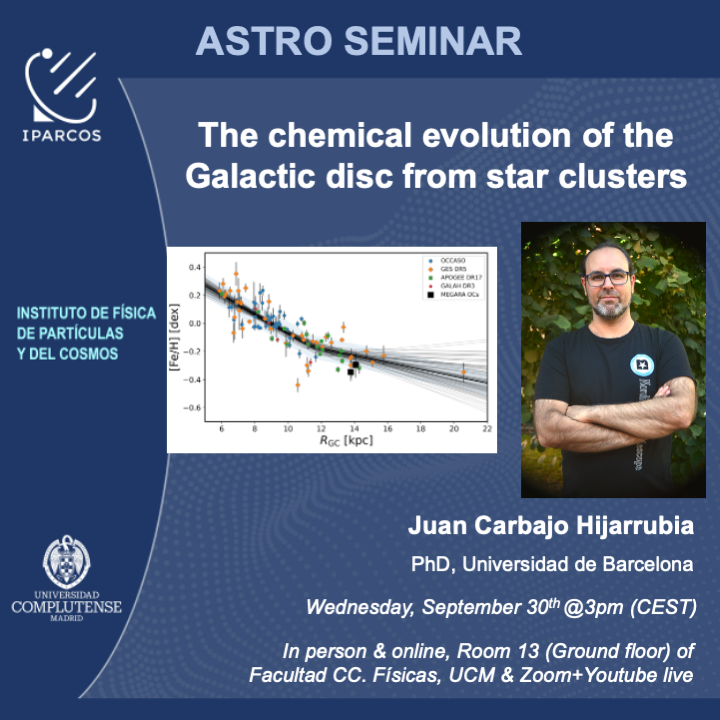
We investigate the chemical evolution of the Galactic disc using open clusters as tracers. These clusters, formed by stars born together, remain gravitationally bound, allowing precise measurements of their distance and age. The research is part of the OCCASO project, which aims to measure accurate elemental abundances using high-resolution spectra (R > 60,000) obtained with FIES, HERMES, and CAFE instruments at the telescopes NOT, Mercator and CAHA2.2 respectively. By the present date, 38 observation campaigns were conducted, increasing the number of observed clusters from 18 to 71, covering a wide range of ages (0.1-7.25 Ga) and Galactocentric radii (6.4-11.7 kpc). Radial velocities were determined for 49 clusters, and combining these with Gaia astrometry allowed the calculation of their kinematics and orbits, consistent with the thin Galactic disc. Abundances for 25 elements were determined with precisions around 0.05 dex, showing cluster chemical homogeneity. The study of radial gradients revealed that the [Fe/H] gradient flattens beyond 11.3±0.8 kpc, suggesting the flattening event occurred over 1 Ga ago, likely due to radial migration. Other elements showed different gradient behaviours, with alpha-elements and [Zn/Fe] showing positive gradients, and neutron-capture elements showing generally positive gradients. Outer disc clusters observed with MEGARA exhibited abundance patterns consistent with those of other clusters in the literature from this region of the disc.
Armando Gil de Paz