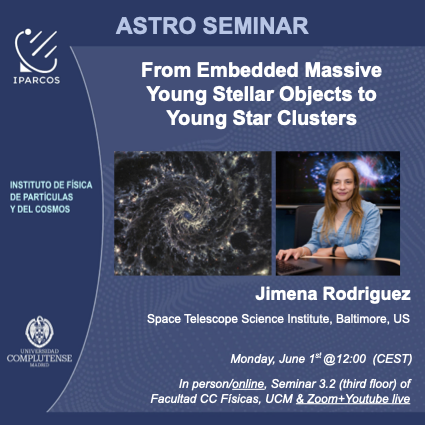
From embedded Massive Young Stellar Objects to Young Star Clusters
by
Seminario 3.2
Facultad de Ciencias Físicas
The physics of star cluster formation is highly multiscale, with nascent star clusters exhibiting widely varying physical conditions on scales <1 to 10s of pc. The smallest scales can only be reached in the Milky Way and Magellanic Clouds, but it is important to connect what we learn there to the much larger sample sizes and range of physical conditions in nearby galaxies, where the resolution is lower.
In this talk, I will present two projects that help bridge these scales to better understand star and cluster formation: First, we identify massive young stellar object (MYSO) candidates in four nearby galaxies (1–5 Mpc) using JWST NIRCam and MIRI imaging. We define mid-infrared color selection criteria and assess the impact of spatial resolution. We find that while the color selection remains stable with distance, blending and surface-brightness effects significantly bias samples at larger distances. Spatial resolution also affects the interpretation of mid-infrared emission: clustering increases the fraction of emission attributed to compact sources in active regions, while blending into diffuse emission dominates in more quiescent environments. This analysis establishes a practical limit of ~3 Mpc for studying individual MYSOs with JWST.
Second, in the local Universe, we are studying the kinematics of young star clusters, specifically the low-metallicity cluster NGC 602 in the Small Magellanic Cloud using VLT/MUSE spectroscopy combined with HST and JWST imaging. We identify cluster members and find evidence for multiple stellar velocity components, likely reflecting the cluster’s formation through cloud–cloud interactions. The observed stellar kinematics place constraints on the cluster’s dynamical state and dispersal timescale.
Patricia Sánchez Blázquez