Choose timezone
Your profile timezone:
Ionized gas is one of the fundamental components of galaxies. By studying its physical conditions, such as density, temperature, pressure, and chemical composition, we can investigate the formation and evolution of these systems and of the Universe as a whole. To determine these parameters, we use diagnostics based on emission-line ratios. After correcting for extinction, we determine the electron density using the bright [SII]λλ6717,6731 or [OII]λλ3726,3729 lines and, when possible, the temperature using [NII]λλ5755,6584 or [OIII]λλ4363,5007. Once these parameters are determined, we can derive masses, pressures, and chemical abundances with great precision, at least in principle.
However, weaker density tracers often yield puzzling discrepancies, with estimated values differing by up to two orders of magnitude. Traditionally, it has been easy to dismiss these discrepancies: perhaps the atomic data are incorrect, perhaps the lines probe a different ionization zone, or perhaps they are simply too faint to be reliable. Besides, if we can barely detect these lines in the first place, what use are they? But the next generation of 30-meter telescopes will routinely detect these lines in star-forming regions across the Universe, leaving us with no choice but to understand exactly what they are telling us.
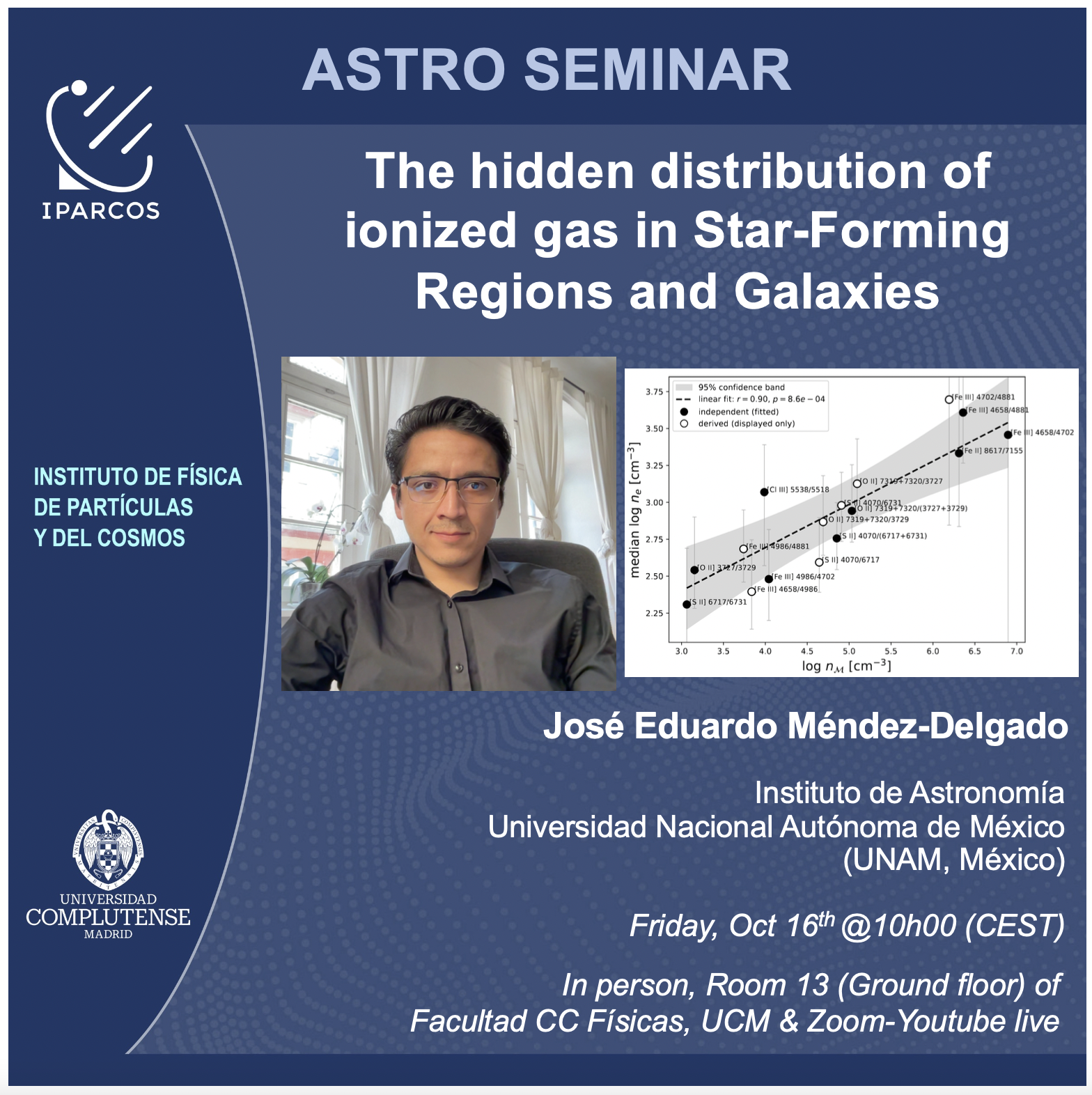
In this talk, I will show that these discrepancies contain fundamental physical information. Using deep observations of the Orion Nebula obtained with the Sloan Digital Sky Survey V (SDSS-V) Local Volume Mapper (LVM), we simultaneously measure 16 density diagnostics originating from the same region of gas projected on the sky. We find that the differences between their inferred densities are not random. Instead, the densities follow a systematic ordering according to the atomic properties of each diagnostic, revealing a broad distribution of gas densities.
This hierarchy is also observed in other star-forming regions in the Milky Way, nearby galaxies, and high-redshift systems. I will discuss how this broad density distribution could change our interpretation of many properties of ionized gas throughout the Universe.
Enrica Bellocchi